
Gout is a type of arthritis that causes sudden, severe joint pain, and it is caused by having too much uric acid in the blood (NHS). People search for "foods to eat" lists when they want a plan. The honest starting point is that food is one part of it. The 2020 American College of Rheumatology guideline says diet changes likely make only small changes to uric acid levels, but that dietary factors may act as triggers for attacks (FitzGerald et al., 2020). This piece looks at the staples you keep in the kitchen and checks each one against what the research says.
This article is general information, not medical advice. If you have gout, follow the food list and treatment your own doctor gives you.
Check the drawer against the purine list
A drawer of nuts, oats, tinned fish and dried fruit sounds sensible for anyone. For gout it needs a second look. In a case-crossover study of 633 people with gout, a 2-day period in the highest fifth of purine intake carried 4.76 times the odds of a gout attack compared with a 2-day period in the lowest fifth (Zhang et al., 2012).
The foods the researchers counted as high in purine were meats, organ meats, meat extracts and gravies, seafood, beans, peas, lentils, oatmeal, spinach, asparagus, mushroom, yeast, beer and other alcoholic drinks. So two of those drawer staples, oats and tinned fish, are on it. Purine from animal sources carried the higher risk: the top fifth of animal purine had odds of 2.41, against 1.39 for plant purine. The authors concluded that cutting back on purine-rich foods, especially of animal origin, may help reduce attacks.
They also wrote that plant foods, especially nuts and legumes, should be the preferred protein sources for people with gout. That makes nuts the easier keeper in the drawer, and it means the tinned fish is the item to use less often.
Cook twice, with lentils or beans in the pot
Pick one evening a week to cook double. A pot of dhal or a bean stew splits into containers for the next few days and takes the "what do I eat" question off the table. Lentils and beans are on the high-purine list too, but they are plant foods, the kind Zhang and colleagues pointed to as the better protein choice.
Keep each container to one normal serving. The NHS lists eating a very large meal, along with drinking too much alcohol, among the things that can trigger a gout attack.
The ACR guideline describes a small trial of 29 patients who were all on uric acid-lowering treatment, with uric acid already at target when it began. Education about a low-purine diet improved what they knew about food but did not lower uric acid compared with a usual-diet group. In that group, knowing the list did not lower uric acid any further. Cooking ahead helps you follow your doctor's food list. It is not a treatment by itself.
What goes in the drinks cupboard
A 12-year study of 46,393 men with no history of gout recorded 755 new cases (Choi and Curhan, 2008). Compared with less than one sugar-sweetened soft drink a month, two or more a day carried a relative risk of 1.85. Diet soft drinks were not linked with gout, while total fruit juice and fructose-rich fruits such as apples and oranges were linked with a higher risk.
The ACR guideline conditionally recommends limiting high-fructose corn syrup, though it rates the evidence as very low and notes there were no data focused on patients who already have gout. The NHS advice is simpler: do not have lots of sugary drinks and snacks, drink plenty of fluids to avoid getting dehydrated, have some alcohol-free days each week and keep to no more than 14 units of alcohol a week. Stocking water in place of soft drinks covers more than one of those at once.
Dates in the drawer
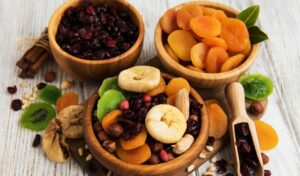
Dates are a fructose-rich fruit. USDA FoodData Central lists 32.0 g of fructose per 100 g of Medjool dates and 19.6 g per 100 g of Deglet Noor dates. None of the studies above tested dates themselves, so they give no evidence that dates trigger gout attacks or that they prevent them.
The NHS 5 A Day page counts a 30 g portion of dried fruit, dates included, as one of your 5 A Day, and says it should be eaten at mealtimes, not as a snack between meals, to reduce the impact on teeth (NHS). So dates work as the sweet finish to a meal rather than something to graze on from the drawer. Weigh 30 g once to learn what it looks like.
A note on your doctor's list
The NHS says your doctor may give you a list of foods to include or limit, and that uric acid-lowering medicine should be taken regularly, even when you no longer have symptoms. Vitamin C is one place where sources differ. The NHS says to ask a GP about vitamin C supplements, while the ACR guideline conditionally recommends against adding them, after two small trials of 29 and 40 patients showed clinically insignificant changes in uric acid. Ask your own doctor before buying any.
None of this needs a whole new diet. Check the drawer against the purine list, cook the lentils twice, keep water ahead of soft drinks and eat dates with a meal.
We supply a range of quality kurma at Kurma Distributor if you want a reliable dried-fruit staple for that drawer. Read more about us on our About Us page. For questions about a variety, the contact page has our WhatsApp number.
References
- NHS. Gout. https://www.nhs.uk/conditions/gout/
- NHS. 5 A Day: what counts? https://www.nhs.uk/live-well/eat-well/5-a-day/5-a-day-what-counts/
- FitzGerald JD, et al. 2020 American College of Rheumatology Guideline for the Management of Gout. Arthritis Care Res (Hoboken). 2020;72(6):744-760. PMID 32391934
- Zhang Y, et al. Purine-rich foods intake and recurrent gout attacks. Ann Rheum Dis. 2012;71(9):1448-53. PMID 22648933
- Choi HK, Curhan G. Soft drinks, fructose consumption, and the risk of gout in men: prospective cohort study. BMJ. 2008;336(7639):309-12. PMID 18244959
- USDA FoodData Central (SR Legacy). Dates, medjool, FDC 168191. https://fdc.nal.usda.gov/food-details/168191/nutrients
- USDA FoodData Central (SR Legacy). Dates, deglet noor, FDC 171726. https://fdc.nal.usda.gov/food-details/171726/nutrients