
This post takes five foods with a fat-burning reputation: green tea, chilli, vinegar, chia seeds and MCT oil. Each one has been tested on people. Here is what those studies found, in plain numbers. Most of the results are small. Two are close to zero.
1. Green tea, as pooled by Cochrane
A Cochrane review pulled together randomised trials of green tea preparations in overweight or obese adults, each lasting at least 12 weeks (PubMed 23235664). Six studies run outside Japan could be pooled, covering 532 people. The average difference in weight loss against the control groups was 0.04kg, and it was not statistically significant.
Eight studies from Japan, with 1,030 people, were too different from each other to combine. Their results ranged from 0.2kg to 3.5kg in favour of green tea. The reviewers concluded that green tea preparations appear to produce a small, non-significant weight loss that is not likely to be clinically important. Green tea also made no significant difference to keeping weight off after losing it.
2. Chilli before a meal
Capsaicinoids are chemicals found naturally in chilli peppers. A meta-analysis from Manchester combined 8 trials with 191 participants (PubMed 24246368). Taking capsaicinoids before a meal cut the amount eaten at that meal by 74 kcal on average.
The authors asked readers to treat that figure with some caution, because the results varied a lot between studies. They estimated that at least 2mg of capsaicinoids was needed for an effect. That figure is for the meal eaten straight after the chilli. The review itself called for longer trials to see what it adds up to over months.
3. Vinegar in a daily drink
In a Japanese trial, obese participants drank 500ml a day of a drink containing 15ml of vinegar, 30ml of vinegar, or none, for 12 weeks (PubMed 19661687). It was double-blind, so neither the participants nor the researchers knew who had which drink. Body weight, BMI and waist size ended up significantly lower in both vinegar groups than in the group with no vinegar.
Two details matter here. The abstract does not give the size of the difference in kilograms. And the authors listed the Central Research Institute of Mizkan Group Corporation as their workplace. A single trial run by company researchers is a starting point, not a settled answer.
4. Chia seeds in water
Chia seeds have a lot of fibre, and that was the reason for testing them. At Appalachian State University, 90 overweight or obese adults aged 20 to 70 were randomised to chia seed or a placebo (PubMed 19628108). They took 25g mixed into 250ml of water twice a day, before the first and last meal, for 12 weeks. 76 people finished.
The result was a clear no. Eating 50g of chia a day had no influence on body mass or body composition compared with placebo. The researchers had expected a small loss, and the title of their paper says chia seed does not promote weight loss.
5. MCT oil in place of other fats
MCT means medium-chain triglycerides, a type of fat. A meta-analysis combined 13 randomised trials with 749 adults, each lasting more than three weeks (PubMed 25636220). It compared two specific MCTs, known as C8:0 and C10:0, with ordinary long-chain fats.
People on the MCTs lost 0.51kg more and 1.46cm more off the waist. The authors called this a modest reduction. They also noted that many trials gave too little detail to judge their quality, that commercial bias was detected, and that larger studies by independent groups were still needed. The review tested MCT in place of other fat, not added on top of a normal diet.
What the five have in common
Put the numbers side by side. Green tea outside Japan: 0.04kg. Chia: no effect. MCT: about half a kilo. Chilli: 74 kcal off one meal. Vinegar: significant, but from one company-run trial with no kilogram figure in its summary. None of these works like a pill.
Where dates sit on this list
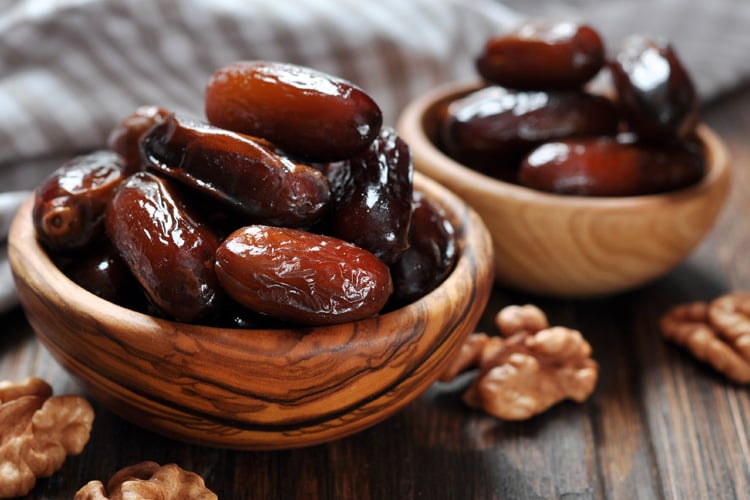
Dates are not on it. None of the trials above tested them, and no one should sell dates as a fat burner. They are a sweet, dried fruit with a known energy content. USDA FoodData Central lists Medjool dates at 277 kcal per 100g with 6.7g of fibre, and Deglet Noor at 282 kcal with 8.0g of fibre.
The NHS says a 30g portion of dried fruit, such as dates, counts as 1 of your 5 A Day, but should be eaten at mealtimes, not as a snack between meals, to reduce the impact on teeth. That 30g of Medjool comes to about 83 kcal, and 30g of Deglet Noor to about 85 kcal. If you like dates, weigh out 30g once so you know what a portion looks like, and eat it with a meal.
Buying dates from Kurma Distributor
Kurma Distributor supplies dates for retail and wholesale buyers and delivers across Malaysia, as its about us page explains. Customer service and price quotes are handled on WhatsApp, with the number on the contact page. Other articles about dates are on the Kurma Distributor blog.
An earlier version of this post linked to https://KurmaHarga.com, and that link stays here.
This article is general information, not personal advice. If you plan a big change to the way you eat, speak to your GP or a dietitian first.